

Giáo án Tiếng Anh 8 - Unit 5: Our customs and traditions - Lesson 1 - Trường THCS Đông Tây Hưng
 36 trang
05/04/2026
730
36 trang
05/04/2026
730
Bạn đang xem 20 trang mẫu của tài liệu "Giáo án Tiếng Anh 8 - Unit 5: Our customs and traditions - Lesson 1 - Trường THCS Đông Tây Hưng", để tải tài liệu gốc về máy hãy click vào nút Download ở trên.
Tóm tắt nội dung tài liệu: Giáo án Tiếng Anh 8 - Unit 5: Our customs and traditions - Lesson 1 - Trường THCS Đông Tây Hưng
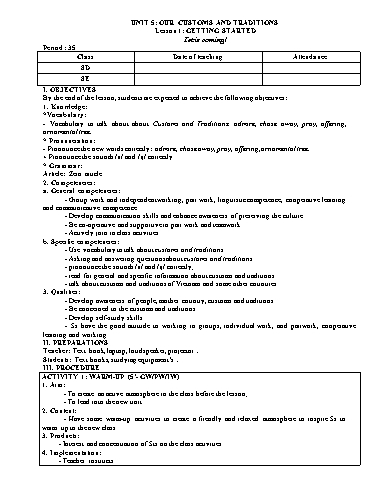
 UNIT 5: OUR CUSTOMS AND TRADITIONS
 Lesson 1: GETTING STARTED
 Tet is coming!
Period: 35
 Class Date of teaching Attendance
 8D
 8E
I. OBJECTIVES
By the end of the lesson, students are expected to achieve the following objectives:
1. Knowledge:
*Vocabulary:
- Vocabulary to talk about about Customs and Traditions: admire, chase away, pray, offering,
ornamental tree.
* Pronunciation:
- Pronounce the new words correctly: admire, chase away, pray, offering, ornamental tree.
+ Pronounce the sounds /n/ and /ŋ/ correctly
* Grammar:
Article: Zero article
2. Competencies:
a. General competencies:
 - Group work and independent working, pair work, linguistic competence, cooperative learning
and communicative competence.
 - Develop communication skills and enhance awareness of preserving the culture
 - Be co-operative and supportive in pair work and teamwork.
 - Actively join in class activities.
b. Specific competencies:
 - Use vocabulary to talk about customs and traditions
 - Asking and answering questions about customs and traditions
 - pronounce the sounds /n/ and /ŋ/ correctly;
 - read for general and specific information about customs and traditions
 - talk about customs and traditions of Vietnam and some other countries
3. Qualities:
 - Develop awareness of people, mother country, customs and traditions
 - Be concerned to the customs and traditions.
 - Develop self-study skills.
 - Ss have the good attitude to working in groups, individual work, and pairwork, cooperative
learning and working.
II. PREPARATIONS
Teacher: Text book, laptop, loudspeaker, projector
Students: Text books, studying equipment’s .
III. PROCEDURE
ACTIVITY 1: WARM-UP (5’- GW/PW/IW)
1. Aim:
 - To create an active atmosphere in the class before the lesson;
 - To lead into the new unit.
2. Content:
 - Have some warm-up activities to create a friendly and relaxed atmosphere to inspire Ss to
warm up to the new class.
3. Products:
 - Interest and concentration of Sts on the class activities.
4. Implementation:
 - Teacher instructs - Sts do as required
 TEACHER AND STUDENTS' ACTIVITIES CONTENTS
Step 1: Task delivering
- Chatting
Step 2: Task performance
 + Greeting + Greeting ; T_Ss.
 + Chatting. CHATTING
 - Before Ss open their books, ask Ss to list
some activities they often do just before and
during Tet.
 - Draw a mind map on the board to
summarise Ss' ideas. Run a quick poll by a show
of hands to find the most common activities.
 - Point to the most common activities and
say "These activities are what we often do at Tet.
They are our Tet customs and traditions.".
 + Students (Ss) listen and learn how to do
the tasks.
- Write the unit title on the board Our Customs and
Traditions. Have Ss open their books and start the
lesson
Step 3: Report and discussion
- Sts work in group to discuss
- Sts join in the discussion
Step 4: Judgement
- T summarizes the discussion and leads to
Activity 2.
ACTIVITY 2: KNOWLEDGE FORMATION (15'- PW/IW/GW)
1. Aim:
- To set the context for the introductory conversation;
- To introduce the topic of the unit, the vocabulary, the sounds, and the grammar points to be learnt.
- To help Ss understand the conversation
2. Content:
To teach some new words. Read the conversation and find out new words. Focus on topic of the lesson,
grammar points
Read the conversation again and tick T (true) or F (False).
3. Products:
Knowing more new words. Ss know how to pronounce the new words correctly and use them in
appropriate situations.Students know the topic of the unit and be ready for the conversation
4. Implementation:
 TEACHER AND STUDENTS' ACTIVITIES CONTENTS
Step 1: Task delivering
- T sets the scene/ context for the listening and
reading.
Step 2: Task performance
Task 1. Listen and read : Tet is coming! Task 1. Listen and read : Tet is coming!
* Teach vocabulary: * Vocabulary
+ Teacher uses different techniques to teach 1. admire (v) khâm phục
vocab (situation, realia, translation.) 2. chase away xua đuổi
+ Teacher introduces the vocabulary by: 3. pray (v) cầu nguyện
 - providing the pictures 4. offering (n) đồ thờ cúng
 - eliciting the definition of the words 5. ornamental tree cây cảnh
+ Teacher do the “Rub out and remember” checking technique.
* Set the context: have Ss look at the
conversation and the picture and answer some
questions, about the activities people in the
countryside do.
- Ask Ss to look at the picture on pages 50 - 51
and answer the questions below: * Suggested words / phrases: flower
- What can you see in the picture? villages, kumquat trees, peach blossoms,
- Can you guess the places that the picture ornamental trees, offerings,
shows? bamboo pole,
- Elicit answers from Ss. decorative items,
Introduce the two characters: Elena and Trang. chase away
Explain that they are at Trang's house and they bad luck,
are talking about Tet. pray for a lucky new year
- Play the recording twice for Ss to listen and
read along. Have Ss underline the words and
phrases that are related to the topic of the unit
while they are listening and reading.
- Invite some pairs of Ss to read the conversation
aloud.
- Have Ss say the words / phrases in the
conversation that they think are related to the
topic Customs and Traditions. Quickly write
them on one part of the board. Comment on Ss'
answers.
Task 2. Read the conversation again and write Task 2. Read the conversation again and
T (True) or F (False). write T (True) or F (False).
- Ask Ss to read the sentences and guess whether - Work individually.
they are true or false without reading the * Answer key:
conversation again. 1. F (Trang’s cousin is at Sa Dec Flower
- Elicit the answers from Ss. Quickly write these Village.)
answers on the board. 2. T
- Have Ss read the conversation again to check 3. T
their answers. 4. F (plants and flowers are an important part
- Allow Ss to share answers with a partner before of Tet)
checking them as a class. 5. T
- Ask Ss for their answers again, comparing them
to the answers that have been written on the
board before.
- Confirm the correct answers.
Step 3: Report and discussion
- Sts write down the new vocabulary
- T asks, Sts answer some more questions about the
conversation
Step 4: Judgement
- T gives feedback on the reaction of Sts
ACTIVITY 3: PRACTICE (20' - GW/PW/IW)
1. Aim:
- To introduce some vocabulary items related to customs and traditions.
- To introduce some verbs of common use in the topic Customs and Traditions.
- To help Ss broaden their knowledge about New Year customs and traditions from other countries;
- To motivate Ss.
2. Content: - Match the phrases with the correct pictures.
- Complete the sentences with the verbs from the box.
- Doing the QUIZ. New year around the world
3. Products:
- Ss understand the content of the conversation and know the vocabulary related to the topic
4. Implementation:
 TEACHER AND STUDENTS' ACTIVITIES CONTENTS
Step 1: Task delivering
- T let Sts learn Task 3 – Getting Started - Unit 2
Step 2: Task performing
Task 3. Match the phrase with the correct Task 3. Match the phrase with the correct
pictures. pictures.
- Ask Ss to name the things they see in the * Answer key:
pictures. 1. d
- Have Ss work individually to match the phrases 2. a
with the correct pictures. Let them compare their 3. e
answers with a partner. 4. b
- Check the answers with the whole class. 5. c
Confirm the correct answers.
- Have some Ss practise saying the phrases again.
Task 4. Complete the sentences with the verbs Task 4. Complete the sentences with the
from the box . verbs from the box .
- Have Ss look at the verbs in the box. Check if * Answer key:
they know these verbs. 1. place
- Have Ss read the sentences and complete each 2. admire
sentence with a verb from the box. 3. chase
- Ask for Ss'answers and confirm the correct 4. pray
ones.
- Have some Ss read aloud the completed
sentences.
- For more able classes, challenge them to think
of other words that can go with the given verbs.
Task 5. Quiz New Years around the world. Task 5. Quiz New Years around the world.
People around the world celebrate New Years People around the world celebrate New Years
differently. Choose the country with each differently. Choose the country with each
tradition below. tradition below.
- Have Ss work in pairs and compete with each * Answer key:
other. 1. B
- Set time (3 minutes) for pairs to do this activity. 2. A
The first pair to finish calls out"Bingo!" 3. A
- Check answers with the whole class. 4. B
Compliment those with all correct answers. 5. B
- Fora more able class, ask each pair to write two
questions about New Year customs and traditions
of two countries they know. Collect the questions
and read aloud some of them. Ss compete to
answer the questions.The one with the most
correct answers wins the game.
Step 3: Report and discussion
- Ss work independently
- Share the answers
Step 4: Judgement
 - T gives feedback on the answers. ACTIVITY 4: APPLICATION (5'- WC )
1. Aim:
To consolidate what Ss have learnt in the lesson.
To review the lesson and prepare for the next lesson.
To give Home assigment
2. Content:
Home assigment
3. Products:
Know more some words about Ethnic groups of Vietnam
Take note Home assigment
4. Implementation:
 TEACHER AND STUDENTS' ACTIVITIES CONTENTS
Step 1: Task delivering (Home assignment)
- Ask one or two Ss to tell the class what they
have learnt.
- Ask Ss to say some words / phrases and
grammar points they remember from the lesson.
Tell Ss that they will learn these language points
in the following lessons.
- Home assigment * Home assigments:
Step 2: Task performance - Do more exercises in workbook.
-T asks Ss to talk about what they have learnt in - Prepare new lesson: Lesson 2: A CLOSER
the lesson. LOOK _1
- T let Sts take note the home assigments.
Step 3: Report and discussion
- T says something about the class time.
-Step 4: Judgement
T gives feedback and requires Sts do homework.
IV. FEED-BACK:
 .
 .
 .. UNIT 5: OUR CUSTOMS AND TRADITIONS
 Lesson 2: A CLOSER LOOK 1
Period: 36
 Class Date of teaching Attendance
 8D
 8E
I. OBJECTIVES
By the end of the lesson, students are expected to achieve the following objectives:
1. Knowledge:
*Vocabulary:
- Vocabulary to talk about about Customs and Traditions: wedding ceremony, whale worship, food
offering, family reunion, martial arts, festival goers, arcrobat, maintain, longevity.
* Pronunciation:
- Pronounce the new words correctly: wedding ceremony, whale worship, food offering, family
reunion, martial arts, festival goers, arcrobat, maintain, longevity.
+ Pronounce the sounds /n/ and /ŋ/ correctly
* Grammar:
Article: Zero article
2. Competencies:
a. General competencies:
 - Group work and independent working, pair work, linguistic competence, cooperative learning
and communicative competence.
 - Develop communication skills and enhance awareness of preserving the culture
 - Be co-operative and supportive in pair work and teamwork.
 - Actively join in class activities.
b. Specific competencies:
 - Use vocabulary to talk about customs and traditions
 - Asking and answering questions about customs and traditions
 - pronounce the sounds /n/ and /ŋ/ correctly;
 - read for general and specific information about customs and traditions
 - talk about customs and traditions of Vietnam and some other countries
3. Qualities:
 - Develop awareness of people, mother country, customs and traditions
 - Be concerned to the customs and traditions.
 - Develop self-study skills.
 - Ss have the good attitude to working in groups, individual work, and pairwork, cooperative
learning and working.
II. PREPARATIONS
Teacher: Text book, laptop, loudspeaker, projector
Students: Text books, studying equipment’s .
III. PROCEDURE
 ACTIVITY 1: WARM-UP (5’- GW/PW/IW)
 1. Aim:
 - Revise the old lesson.
 - Do some activities to creat a friendly and relaxed atmostphere to warm up to the new
 lesson
 2. Content:
 - Have some warm-up activities to create a friendly and relaxed atmosphere to inspire Ss to
 warm up to the new class.
 - Guessing game
 3. Products: - Interest and concentration of Sts on the class activities.
 - A friendly and relaxed atmostphere to the new lesson
 - Having a chance to speak English and focus on the topic of the lesson..
4. Implementation:
 - Teacher instructs
 - Sts do as required
TEACHER AND STUDENTS' ACTIVITIES CONTENTS
Step 1: Task delivering
- Chatting
Step 2: Task performance + Greeting ; - T_Ss.
 + Greeting + Game: Hidden pictures game:
 + Game: Hidden pictures game: Suggested answers:
 - Teacher divides the class into 8 groups 1. family reunion
and gives instructions. 2. wedding ceremony
 - The teacher slowly removes the squares 3. food offerings
while the groups write the answers on their mini 4. Tet holiday
boards. 5. lucky money
 - The groups that guesses the right word
will have the points.
 - Lead into this lesson .
 OR: Scramble the letters of some
keywords from GETTING STARTED. Make
sure to include the words "custom" and
"tradition".
 Have Ss compete to order the letters
correctly. Lead into this lesson which focuses on
phrases and expressions related to customs and
traditions and the sounds Ini and /q/.
 Share with Ss the objectives of the
lesson by showing them on a projector.
Alternatively, write the objectives in a corner of
the board and leave them there and tick the
objectives off when the class finishes with them.
 Ask Ss to open their books and start the
lesson.
Step 3: Report and discussion
- Sts join in the discussion
Step 4: Judgement
- T summarizes the discussion and leads to
Activity 2.
ACTIVITY 2: KNOWLEDGE FORMATION (15'- PW/GW/IW)
1. Aim:
To present some phrases related to customs and traditions.
To help Ss practise using the words related to customs and traditions in context.
2. Content:
Vocabulary pre-teach. Write a phrase from the box under each picture.
3. Products:
Ss know how to pronounce the new words correctly and use them in appropriate situations.
4. Implementation:
TEACHER AND STUDENTS' ACTIVITIES CONTENTS
Step 1: Task delivering
- T sets the scene/ context for the reading and
vocabulary learning - T ask the whole class to do the Tasks in A Closer
Look 1
Step 2: Task performance
Task 1. Write a phrase from the box under Task 1. Write a phrase from the box under
each picture. each picture.
 * Teach vocabulary: * New words:
 + Teacher uses different techniques to 1. wedding ceremony lễ cưới
teach vocab (situation, realia, translation.) 2. whale worship tục thờ cá Ông
 + Teacher introduces the vocabulary by: 3. food offerings đồ ăn cúng
 - providing the pictures 4. family reunion đoàn tụ gia đình
 - eliciting the definition of the words 5. martial arts (n) võ thuật
 + Teacher do the checking “What and 6. festival goer người tham gia lễ hội
where?” 7. acrobat (n) vận động viên nhào lộn
 - Teacher has students read the phrases 8. maintain (v) duy trì
aloud and correct their pronunciation if 9. longevity (n) sự sống lâu, tuổi thọ
necessary.
 - Teacher asks students for the
Vietnamese meanings of these phrases. *** Answer key:
 - Ss say the words. 1. family reunion
 - Other Ss correct if the previous 2. wedding ceremony
answers are incorrect. 3. food offerings
- Teacher shows and says the words aloud and 4. whale worship
asks Ss to repeat them. 5. martial arts
 ** Have Ss look at the pictures and name 6. festival goers
the things, events, and people seen in the
pictures.
 Have Ss read the phrases in the box and
match them with the appropriate pictures.
 Let Ss work in pairs to compare their
answers before offering the answers.
 Check and confirm the correct answers
as a class. Elicit from Ss the clue(s) that help(s)
them to complete the matching task (expected
answer: words like wedding, food, whale,
family, festival are familiar to them and can be
easily linked to the corresponding pictures).
Task 2: Complete each sentence with the Task 2. Complete each sentence with the
correct option A, B, or C. correct option A, B, or C.
 - Have Ss do this exercise individually. * Answer key:
Tell them to read all the sentences carefully to 1. A
make sure they understand the sentences and 2. C
choose the correct options. 3. B
 - Have them share their answers in pairs. 4. B
 - Invite some Ss to give their answers 5. A
and confirm the correct ones. Explain the Note: 1. hold a family reunion but have a
options that challenge Ss. family meal
With a more able class, challenge Ss to list new
phrases. For example, write "family ____ ",
",____ ceremony", "worshipping ______ " on
the board, and have Ss think of appropriate
words to fill in the blanks.
Step 3: Report and discussion
- Sts write down the new vocabulary - T asks, Sts answer some more questions about the
lesson
Step 4: Judgement
- T gives feedback on the reaction of Sts
ACTIVITY 3: PRACTICE (20' - GW/PW/IW)
1. Aim:
To give Ss further practice with expressions about customs and traditions
To help Ss identify howto pronounce the sounds /n/ and /ŋ/.
To help Ss practise pronouncing these sounds in words.
To help Ss broaden their knowledge about New Year customs and traditions from other countries;
To motivate Ss.
2. Content:
Complete the sentences with the words from the box.
Listen and repeat the words. Pay attention to the sounds /n/ and /ŋ/. Listen and practise the
sentences. Underline the words with the sound /n/ and circle the words with the sound /ŋ/.
3. Products:
Know more new verbs and verb phrases. Know how to use the words/ phrases in context.
Students can pronounce the sound /n/ and /ŋ/ correctly.
4. Implementation:
TEACHER AND STUDENTS' ACTIVITIES CONTENTS
Step 1: Task delivering
- T let Sts learn Task3- 4-5 – A Closer look 1
Step 2: Task performing
Task 3. Complete the sentences with the word Task 3. Complete the sentences with the
and phrases from the box. word and phrases from the box.
 - Go over the words in the box with Ss. * Answer key:
Make sure Ss understand them before moving 1. break
on. For example, draw Ss' attention to "break 2. Traditionally
with tradition" and have them guess its 3. practise
meaning. Also, tell them that the verb "practise" 4. keep
can go with "customs" or "traditions". 5. custom
 - Have Ss read the sentences in pairs and
choose the appropriate words to complete the
sentences.
 Invite Ss to share their sentences orally
or in the writing.
 - Confirm the correct answers as a class.
 - Have Ss choose one or two expressions
and make sentences with them
 - Teacher checks students’ pronunciation
and gives feedback.
 - T checks the exercises and gives
feedback.
Task 4. Listen and repeat the words. Pay Task 4. Listen and repeat the words. Pay
attention to the sounds /n/ and /ŋ/. attention to the sounds /n/ and /ŋ/.
 - Have some Ss read out the words first.
Then play the recording for them to listen and
repeat the words they hear.
 - Play the recording as many times as
necessary.
 - Explain to Ss that these words have the
sounds / n / and /q/.Tell them howto make the
two sounds and have them practise saying the sounds several times.
 - Go over the list of the words again with
Ss. Draw their attention to the words like
longevity, thank, and language.
 - Ask Ss to work in pairs to practise
saying the words.
- Invite some Ss to say some words they know
that include either of the two sounds.
Task 5. Listen and practise the sentences. Task 5. Listen and practise the sentences.
Underline the words with the sound /n/ and Underline the words with the sound /n/ and
circle the words with the sound /ŋ/. circle the words with the sound /ŋ/.
 - Have Ss quickly read the sentences. * Answer:
Now play the recording for Ss to listen to the
sentences. - Ask them to underline the words 1. Mary wore a pink dress last night.
with the sound /n/ and circle the words with the 2. I think we should buy this ornamental tree.
sound /t]/. 3. He thanked the host for the enjoyable party.
 - Invite some Ss to share their answers. 4. My mum made the spring rolls for the
 - Confirm the correct ones. longevity party.
 - Play the recording again for Ss to 5. I will bring some food to the party on
repeat the sentences. Saturday.
 - Have Ss practise the sentences in pairs.
Invite some pairs to read the sentences aloud.
 - Comment on their pronunciation of the
sounds.
Step 3: Report and discussion
- Ss work independently
- Share the answers
Step 4: Judgement
 - T gives feedback on the answers and studying
attitucde of Sts in class.
ACTIVITY 4: APPLICATION (5' - WC)
1. Aim:
To consolidate what students have learnt in the lesson.
To reactivate the knowledge that students have gained
2. Content:
Make sentences using the new words and structures
Home assigment
3. Products:
Know more some words about community service
Take note Home assigment
4. Implementation:
TEACHER AND STUDENTS' ACTIVITIES CONTENTS
Step 1: Task delivering (Home assignment)
- Ask one or two Ss to tell the class what they have
learnt.
- Ask Ss to say aloud some words they remember
from the lesson and make sentences with them
- Home assigment
Step 2: Task performance
- Teacher summarizes the lesson - T let Sts take note the home assignment
 * Home assigment:
 - Remember some new words.
 - Do more exercises in workbook.
Step 3: Report and discussion - Prepare new lesson. A CLOSER
- T asks, Sts answer about volunteer work LOOK_ 2
-Step 4: Judgement
T gives feedback and requires Sts do homework.
 IV. FEED-BACK:
 .
 .
 .. UNIT 5: OUR CUSTOMS AND TRADITIONS
 Lesson 3: A CLOSER LOOK 2
Period: 37
 Class Date of teaching Attendance
 8D
 8E
I. OBJECTIVES
By the end of the lesson, students are expected to achieve the following objectives:
1. Knowledge:
*Vocabulary:
- Vocabulary to talk about about Customs and Traditions.
* Pronunciation:
- Pronounce the new words correctly.
* Grammar:
Use the article (a / an, the, the zero articles)
2. Competencies:
a. General competencies:
 - Group work and independent working, pair work, linguistic competence, cooperative learning
and communicative competence.
 - Develop communication skills and enhance awareness of preserving the culture
 - Be co-operative and supportive in pair work and teamwork.
 - Actively join in class activities.
b. Specific competencies:
 - Use vocabulary to talk about customs and traditions
 - Asking and answering questions about customs and traditions
 - pronounce the sounds /n/ and /ŋ/ correctly;
 - read for general and specific information about customs and traditions
 - talk about customs and traditions of Vietnam and some other countries
3. Qualities:
 - Develop awareness of people, mother country, customs and traditions
 - Be concerned to the customs and traditions.
 - Develop self-study skills.
 - Ss have the good attitude to working in groups, individual work, and pairwork, cooperative
learning and working.
II. PREPARATIONS
Teacher: Text book, laptop, loudspeaker, projector
Students: Text books, studying equipment’s .
III. PROCEDURE
ACTIVITY 1: WARM-UP (5’- GW/PW/IW)
1. Aim:
 - To create an active atmosphere in the class before the lesson;
 - To lead into the new lesson.
2. Content:
Review the previous lesson or have some warm-up activities to create a friendly and relaxed atmosphere
to inspire Ss to warm up to the new lesson.
3. Products:
 - Interest and concentration of Sts on the class activities.
 - A friendly and relaxed atmostphere to the new lesson
 - Having a chance to speak English and focus on the topic of the lesson..
4. Implementation:
 - Teacher instructs - Sts do as required
TEACHER AND STUDENTS' ACTIVITIES CONTENTS
Step 1: Task delivering
- game
Step 2: Task performance
 + Greeting. + Greeting.
 + Teacher (T) asks Ss some questions
about the previous lessons . T may introduce
some warm-up activities to create a friendly and 1. We held a family reunion last week.
relaxed atmosphere to inspire Ss to warm up to 2. My mom prepares food offerings at Tet.
the subject and new class
 * Option 1:
 - Teacher shows the pictures of the
phrases learnt in A CLOSER LOOK 1.
 - Teacher has Ss call out the phrases as
soon as they see the pictures.
 -Teacher writes two sentences on the
board “We held a family reunion last week”, and
“My mom prepares food offerings at Tet”.
Underline the article “a” in sentence 1. T asks Ss
if they find “a” in sentence 2.
 - Teacher asks them what part of speech
“a” is. T asks them if they remember other
articles. T tells them that today they are going to
revise “a, an, the” and learn about “zero article”.
 Write the objectives in the top-left corner
of the board. REVIEW OF A, AN, THE
 Write two sentences on the board:
 - She is an engineer.
 - We held a family reunion last week.
The party was enjoyable.
 - Lead to the lesson.
- Teacher introduces the objectives of the lesson.
Step 3: Report and discussion
- Sts join in the discussion and do as required
Step 4: Judgement
- T summarizes the discussion and leads to
Activity 2.
ACTIVITY 2: KNOWLEDGE FORMATION (15'- PW/IW/GW)
1. Aim:
- To help Ss identify the use of articles at the sentence level.
- To help Ss recognise the correct use of articles.
- To give Ss further practice with articles at sentence level. Or at text level
2. Content:
- Review articles: “a, an, the” and teach how to use the zero article.
- Choose the correct option in each sentence below.
- Which of the underlined parts in each question is incorrect? Find and correct it.
- Complete the sentences with “a, an, the, or Ø” (zero article).
- Complete the text with “the” or “Ø” (zero article).
3. Products:
- Ss know how to form and use: The article a / an, the and zero article
4. Implementation:
 TEACHER AND STUDENTS' ACTIVITIES CONTENTS Step 1: Task delivering
- T sets the scene/ context for the listening and reading.
- T ask the whole class to do the Tasks in A Closer
Look 2
Step 2: Task performance
Task 1. Choose the correct option in each Task 1. Choose the correct option in each
sentence below sentence below
 * Pre-teach vocabulary: New words:
 + Teacher uses different techniques to teach 1. harvest (v)
vocab (situation, realia, translation.) if have 2. crop (n)
 - Explain that sometimes, we can use nouns 3. waterwheel (n)
without a / an or the. We call this case zero article.
 - Go through the Remember! box with Ss.
Draw their attention to the example sentence for
each case.
 - Have them identify the uncountable noun, Answer key:
the general statement and the general form of 1. an
transport in each example sentence. 2. a
 - Encourage Ss to give their own examples. 3. Ø
 * Have Ss do this exercise individually and 4. Ø
then compare their answers with a partner. 5. the
 - Ask some Ss to share their answers and
has them explain their choices.
 - T confirms the correct answers
Task 2. Which of the underlined parts in each Task 2. Which of the underlined parts in
question is incorrect? Find and correct it. each question is incorrect? Find and
 - Show a picture of the Kitchen Gods correct it.
Worshipping Ceremony. Encourage Ss to say aloud
what they know about the ceremony (when it is,
what happens, etc.)
 - Tell Ss that they are going to read
sentences about this ceremony. Tell them that one
of the articles in each sentence is not used *
correctly.
 - Teacher demonstrates the activity with the Answer key:
first sentence (find the mistake and correct it). 1. A (The → Ø)
 - Have Ss do this exercise individually and 2. C (a → the)
then compare the answers with another classmate. 3. B (the → Ø)
 - Invite some Ss to write their answers on 4. C (a → Ø)
the board. 5. A (The → Ø)
 - Check the answers with the whole class.
Have some Ss explain their answers.
- T confirms the correct answers.
Step 3: Report and discussion
- Sts write down the new vocabulary
- T asks, Sts answer some more questions about the
lesson
Step 4: Judgement
- T gives feedback on the reaction of Sts
ACTIVITY 3: PRACTICE (20' - GW/PW/IW)
1. Aim:
- To give Ss further practice with articles at sentence level
- To give further practice with articles . To help Ss use articles correctly. 2. Content:
- Complete the sentences with a, an, the, or Ø (zero article).
- Complete the text with the or Ø (zero article).
- Playing GAME: Bingo
3. Products:
- Ss know how to form and use: The article a / an, the and zero article
- Students can use the articles correctly
 TEACHER AND STUDENTS' ACTIVITIES CONTENTS
Step 1: Task delivering
- T let Sts study the examples, consume the rules and
do the exercises
Step 2: Task performing
Task 3. Complete the sentences with a, an, the, Task 3. Complete the sentences with a, an,
or Ø (zero article the, or Ø (zero article
- Have Ss do this exercise individually and then * Answer key:
compare their answers with a partner. 1. Ø
- Ask some Ss to share their answers and have 2. a
them explain their choice. Confirm the correct 3. Ø
answers. 4. the
* Teacher gets feedback and confirms the correct 5. an
answers.
Task 4. Complete the text with the or Ø (zero Task 4. Complete the text with the or Ø
article). (zero article).
 - Write on the board (or shows pictures on * Answer key:
the slide) the following activities: playing cards, 1. the
watching TV, singing karaoke. 2. Ø
 - Ask Ss if their family often does these 3. Ø
activities together. Teacher tells Ss that we call 4. Ø
activities that a family often do together family 5. the
time traditions.
 - Tell Ss that the text is about the benefits of
family time traditions, and they have to read
 and complete the blanks with the or Ø (zero
article).
 - Have Ss work individually to complete the
text.
 - Invite some Ss to write their answers on
the board. Have Ss explain their answers.
 - Teacher confirms the answers.
- For a stronger class, T asks them to talk about the
benefits of family time traditions. GAME: Bingo!
GAME: Bingo! * Answer key:
- Have Ss work in groups of four or five. 1. I usually meet my cousin at the weekends.
- Give each group a list of five sentences. T tells (the → Ø)
them that there is one mistake in each sentence, 2. My uncle moved to United States three
and they have to find and correct it. years ago. (United States → the United
- Have Ss work in their groups, find and correct the States)
mistakes. They say “Bingo!” as soon as their group 3. Our teachers assigned us a homework for
finishes. our history and science classes. (a → Ø)
- Confirm the correct answers. The first group to 4. I turn off the light and go to the bed at 11
come up with all the correct answers wins. p.m. (the → Ø)
- For stronger classes, T lets groups write two 5. Mark often wears red sweater to match
sentences with article mistakes. T collects the his red hair. (red sweater → a red sweater) sentences and picks out some sentences randomly
for the whole class to find and correct the mistakes.
List of sentences:
1. I usually meet my cousin at the weekends.
2. My uncle moved to United States three years
ago.
3. Our teachers assigned us a homework for our
history and science classes.
4. I turn off the light and go to the bed at 11 p.m.
5. Mark often wears red sweater to match his red
hair
* Teacher’s observation and feedback.
Step 3: Report and discussion
- Ss work independently
- Share the answers
Step 4: Judgement
 - T gives feedback on the answers and studying
attitude of Sts in class.
ACTIVITY 4: APPLICATION (5'- WC )
1. Aim:
To help Ss revise all they have learnt.
To give Home assigment
2. Content:
Make sentences using the the past simple.
Home assigment
3. Products:
Review the old lesson
Take note Home assigment
4. Implementation:
 TEACHER AND STUDENTS' ACTIVITIES CONTENTS
Step 1: Task delivering (Home assignment)
- Ask one or two Ss to tell the class what they have
learnt.
- T asks some Ss to give a sentence about
themselves, using the past simple .
- Home assigment
Step 2: Task performance * Home assigment:
- Teacher summarizes the lesson - Remember the use the prepositions of time
- T lets Sts take note the home assignment and place.
 - Do more exercises in workbook.
 - Prepare new lesson: COMMUNICATION.
Step 3: Report and discussion
- T asks, Sts answer about leisure activities
-Step 4: Judgement
T gives feedback and requires Sts do homework.
 IV. FEED-BACK:
 .
 .
 .. UNIT 5: OUR CUSTOMS AND TRADITIONS
 Lesson 4: COMMUNICATION
Period: 38
 Class Date of teaching Attendance
 8D
 8E
I. OBJECTIVES
By the end of the lesson, students are expected to achieve the following objectives:
1. Knowledge:
*Vocabulary:
- Vocabulary to talk about about table manners; customs and traditions
* Pronunciation:
- Pronounce the new words correctly,
* Grammar:
Article: Zero article
2. Competencies:
a. General competencies:
 - Group work and independent working, pair work, linguistic competence, cooperative learning
and communicative competence.
 - Develop communication skills and enhance awareness of preserving the culture
 - Be co-operative and supportive in pair work and teamwork.
 - Actively join in class activities.
b. Specific competencies:
 - Use vocabulary to talk about customs and traditions
 - Asking and answering questions about customs and traditions
 - Giving advice
 - Read about a local festival
 - Compare two local festivals: The Japanese lion dance and Vietnamese unicorn dance
3. Qualities:
 - Develop awareness of people, mother country, customs and traditions
 - Be concerned to the customs and traditions.
 - Develop self-study skills.
 - Ss have the good attitude to working in groups, individual work, and pairwork, cooperative
learning and working.
II. PREPARATIONS
Teacher: Text book, laptop, loudspeaker, projector
Students: Text books, studying equipment’s .
III. PROCEDURE
 ACTIVITY 1: WARM-UP (5- GW/PW/IW)
 1. Aim:
 - To revise the old lesson.
 - To lead in the targeted vocabulary and pronunciation.
 2. Content:
 - Review the previous leson or have some warm-up activities to creat a friendly and relaxed
 atmostphere to inspire Ss to warm up to the new lesson
 3. Products:
 - Interest and concentration of Sts on the class activities.
 - A friendly and relaxed atmostphere to the new lesson
 - Developing the language skills by asking and answering questions about themselves.
 4. Implementation: - Teacher instructs
 - Sts do as required
TEACHER AND STUDENTS' ACTIVITIES CONTENTS
Step 1: Task delivering
- Chatting
Step 2: Task performance
 + Greeting + Greeting . T_Ss.
 - Show a picture of a child having dinner
with family. Ask Ss what the child is doing and
whether she is behaving well at the table.
 - Tell Ss that “table manners” means the
polite ways of behaving when eating. These
behaviours differ from one culture to another.
 - Ask Ss to give some examples of table
manners that they know. * Suggested answers:
 - Lead in to the lesson. - Wait for the table arrangement before sitting
 - Introduce the objectives of the lesson. down
Write the objectives in top-left corner of the - Wait for the oldest people to start first
board. - Pass your bowl with two hands
 - Do not stick the chopstick against the bowl
 - Do not flip the fish on the plate
 - Do not point the chopsticks to anyone
 - Do not dig into the dish
 - Do not eat directly from shared dishes
 - Stay until other people finish
 - Say Thanks to the host after the meal
 ..
 Step 3: Report and discussion
- Sts join in the discussion and do as required
Step 4: Judgement
- T summarizes the discussion and leads to
Activity 2.
ACTIVITY 2: KNOWLEDGE FORMATION (15'- PW/GW/IW)
1. Aim:
 EVERYDAY ENGLISH
 Giving advice
- To introduce ways of giving advice.
- To help Ss practise giving advice.
2. Content:
- Listen and practise the conversation ;
- Make similar conversations with the following situations.
3. Products:
- Ss understand how to give advice.
- Students can make dialogue by giving advice.
4. Implementation:
TEACHER AND STUDENTS' ACTIVITIES CONTENTS
Step 1: Task delivering
- T sets the scene/ context to reading and listening
- T ask the whole class to do the Tasks in
Communication
Step 2: Task performance
Task 1. Listen and read the conversation Task 1. Listen and read the conversation
below. Pay attention to the highlighted parts. below. Pay attention to the highlighted - Play the recording for Ss to listen and parts.
read the dialogue between Tom and Mai. + Listen and read the conversation:
 - Ask Ss to pay attention to the Tom: My parents are taking me to thei
highlighted language. friend’s house for dinner. Could you tell me a
 - T elicits from Ss that the first two bit about Viet namese table manner?
highlighted phrases are ways to advise what one Mai: Well, perhaps you should wait for
should do, and the last highlighted word is for the host to start eating.
saying what one should NOT do. Tom: I will
 - Have Ss practise the dialogues in pairs. Mai: It’s a good idea to hand bowls
Call on some pairs to practise the dialogues in with both hands.
front of the class. Tom: Sure. I’ll remember that one.
 -> Structure: to give advice Mai: I don’t hit the bowl with your
 - Perhaps you should + V0 chopsticks. This may bring bad luck to the host
 - It’s a good idea to + V0 family.
 - Don’t + V0
* Teacher checks students’ understanding by
asking some checking questions.
Task 2. Work in pairs. Make similar Task 2. Work in pairs. Make similar
conversations with the following situations. - conversations with the following situations. -
Ask Ss to work in pairs (5 minutes) to make Work in pairs
similar dialogues with the given situations, Suggested answers:
using the expressions they have learnt. 1. Perhaps you should bring warm clothes, a
 - Teacher moves around to observe and scarf, coat, jacket,
provide help. 2. It’s a good idea to bring a gift such as a
 - T calls on some pairs to practise in birthday cake, pen, pencil, clothes
front of the class.
 - T comments on their performance.
* Teacher’s observation and feedback
Step 3: Report and discussion
- T asks, Sts answer some more questions about the
lesson
Step 4: Judgement
- T gives feedback on the reaction of Sts
ACTIVITY 3: PRACTICE (20' - GW/PM/IM)
 The Japanese lion dance and Vietnamese unicorn dance
1. Aim:
- To provide Ss with information about lion dance in Japan.
- To help Ss compare the Vietnamese unicorn dance with the Japanese lion dance.
2. Content:
- Read the text about the lion dance in Japan and complete the table with the information from the
text. Read Mai’s notes on the Vietnamese unicorn dance. Compare the Vietnamese unicorn dance
with the Japanese lion dance.
3. Products:
- Ss can understand the text and fill in the blank with right information.
- Students can compare the Vietnamese unicorn dance with the Japanese lion dance.
4. Implementation:
TEACHER AND STUDENTS' ACTIVITIES CONTENTS
Step 1: Task delivering
- T let Sts study the examples, consume the rules
and do the exercises
Step 2: Task performing Task 3. Read the text about the lion dance
Task 3. Read the text about the lion dance in in Japan and complete the table with the
Japan and complete the table with the information from the text. information from the text. * Answer key:
 - Teacher writes “Lion Dance” on the 1. shishi-mai
board or shows a picture of a lion dance. T tells 2. New Year celebrations
Ss that this is called the lion dance and it is 3. acrobatics
popular in many Asian countries. 4. flutes
 - T elicits from Ss the occasion(s) when 5. bad spirits
they may see a lion dance performance.
 - Tell Ss that they are going to read
about lion dance in Japan.
 - Have Ss look at the table of
information and think of the type of information
they need for each
 blank.
 - Ask Ss to work in pairs to do this
activity. They can draw this table on a sheet of
paper. After pairs finish their work, T asks them
to share their table with the whole class.
 - Comment on their answers.
 - If time allows, have some pairs use the
information in the table to talk about the
Japanese lion dance without looking again at the
text. Task 4. Work in groups. Read Mai’s notes
Task 4. Work in groups. Read Mai’s notes on on the Vietnamese unicorn dance. Compare
the Vietnamese unicorn dance. Compare the the Vietnamese unicorn dance with the
Vietnamese unicorn dance with the Japanese Japanese lion dance.
lion dance. Suggested answers:
 - Teacher shows two pictures, one of the - There are one or more performers in
Vietnamese unicorn dance and one of the both Vietnamese Unicorn dance and Japanese
Japanese lion dance next to each other. Lion dance.
 - Have Ss look at the pictures and point - Both Vietnamese Unicorn dance and
out some similarities and differences between Japanese Lion dance perform in the New Year
the two pictures. T encourages Ss to use the Festival.
structures “Both . and ..” and “ . but .”. - Vietnamese Unicorn dance needs Ong
 - Tell Ss to look at Mai’s notes on Dia but Japanese Lion dance doesn’t need it.
Vietnamese unicorn dance. T asks them if there
is any information they didn’t know.
 - Have Ss work in groups to compare the
Vietnamese unicorn dance and the Japanese lion
dance, using the tables in 3 and 4. Tell the
groups that they need to write at least 5
sentences using 5 pieces of information from
the tables.
 - Ask some Ss to report their group’s
answers to the class.
 Culture note:
- There are many forms of lion and unicorn dances
in Asian cultures in general and in Viet Nam in
particular. The form varies by the local culture, the
ethnic group, and even the festival that the dance is
performed.
* T checks Ss’ understanding and gives feed
 back
Step 3: Report and discussion
File đính kèm:
- giao_an_tieng_anh_8_unit_5_our_customs_and_traditions_lesson.docx
