

Giáo án Tiếng Anh 8 - Unit 2: Life in the countryside - Trường THCS Đông Tây Hưng
 35 trang
05/04/2026
680
35 trang
05/04/2026
680
Bạn đang xem 20 trang mẫu của tài liệu "Giáo án Tiếng Anh 8 - Unit 2: Life in the countryside - Trường THCS Đông Tây Hưng", để tải tài liệu gốc về máy hãy click vào nút Download ở trên.
Tóm tắt nội dung tài liệu: Giáo án Tiếng Anh 8 - Unit 2: Life in the countryside - Trường THCS Đông Tây Hưng
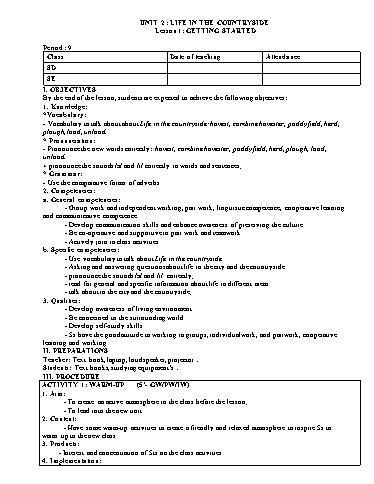
 UNIT 2 : LIFE IN THE COUNTRYSIDE
 Lesson 1: GETTING STARTED
Period: 9
 Class Date of teaching Attendance
 8D
 8E
I. OBJECTIVES
By the end of the lesson, students are expected to achieve the following objectives:
1. Knowledge:
*Vocabulary:
- Vocabulary to talk about about Life in the countryside: havest, combine havester, paddy field, herd,
plough, load, unload.
* Pronunciation:
- Pronounce the new words correctly: havest, combine havester, paddy field, herd, plough, load,
unload.
+ pronounce the sounds /ə/ and /ɪ/ correctly in words and sentences;
* Grammar:
- Use the comparative forms of adverbs
2. Competencies:
a. General competencies:
 - Group work and independent working, pair work, linguistic competence, cooperative learning
and communicative competence.
 - Develop communication skills and enhance awareness of preserving the culture
 - Be co-operative and supportive in pair work and teamwork.
 - Actively join in class activities.
b. Specific competencies:
 - Use vocabulary to talk about Life in the countryside
 - Asking and answering questions about life in the city and the countryside
 - pronounce the sounds /ə/ and /ɪ/ correctly;
 - read for general and specific information about life in different areas
 - talk about in the city and the countryside;
3. Qualities:
 - Develop awareness of living environment
 - Be concerned to the surrounding world.
 - Develop self-study skills.
 - Ss have the good attitude to working in groups, individual work, and pairwork, cooperative
learning and working.
II. PREPARATIONS
Teacher: Text book, laptop, loudspeaker, projector
Students: Text books, studying equipment’s .
III. PROCEDURE
ACTIVITY 1: WARM-UP (5’- GW/PW/IW)
1. Aim:
 - To create an active atmosphere in the class before the lesson;
 - To lead into the new unit.
2. Content:
 - Have some warm-up activities to create a friendly and relaxed atmosphere to inspire Ss to
warm up to the new class.
3. Products:
 - Interest and concentration of Sts on the class activities.
4. Implementation: - Teacher instructs
 - Sts do as required
 TEACHER AND STUDENTS' ACTIVITIES CONTENTS
Step 1: Task delivering
- Chatting
Step 2: Task performance
 + Greeting + Greeting
 +Do some warm up activities before Ss Chatting
open their books.
 + Teacher (T) shows some pictures about
life in the countrside.
- Look at some pictures and answer the questions
:
 + What are they doing?
 + Where are they?
 + Is it in the countryside or in the city?
 - Then ask Ss to decide which leisure
activities are common in the countryside and
why.
 - Lead into the new unit. Write the unit
title Life in the Countryside on the board.
 - Ask Ss to guess what they are going to
learn about in this unit. Then ask Ss to brainstorm
words and phrases describing activities that often
take place in the countryside. For strong classes,
encourage Ss to compare the countryside and the
city.
 + Students (Ss) listen and learn how to do
the tasks.
 - Students Open the book and write the
tittle of the lesson.
Step 3: Report and discussion
- Sts work in group to discuss
- Sts join in the discussion
Step 4: Judgement
- T summarizes the discussion and leads to
Activity 2.
ACTIVITY 2: KNOWLEDGE FORMATION (15'-PW/IW/GW)
1. Aim:
To set the context for the introductory dialogue;
To introduce the topic of the unit.
2. Content:
Learn some new words. Read the conversation and find out new words. Focus on topic of the lesson,
grammar points
Listen and read the conversation. Answer the question.
3. Products:
Knowing more new words. Understanding the conversation; topic of the lesson, grammar points
Understanding more the content of the conversation.
4. Implementation:
 TEACHER AND STUDENTS' ACTIVITIES CONTENTS
Step 1: Task delivering
- T sets the scene/ context for the listening and
reading. Step 2: Task performance
Task 1. Listen and read : LAST SUMMER Task 1. Listen and read : LAST SUMMER
HOLIDAY HOLIDAY
 - Teacher explains the meaning of the new * Vocabulary
vocabulary by pictures. 1. harvest (v) gặt hái, thu hoạch
 - Teacher reveals that the words 2. combine harvester (n) máy gặt
corresponding to the pictures will appear in the 3. herd (v) chăn trâu, bò
reading text and asks students to open their 4. paddy fields (n) ruộng lúa
textbook to find these words.
 * Teach vocabulary:
 + Teacher uses different techniques to
teach vocab (situation, realia, translation.)
 + Teacher introduces the vocabulary by:
 - providing the pictures
 - eliciting the definition of the words
 + Teacher do the “Rub out and
remember” checking technique.
 Set the context: have Ss look at the
conversation and the picture and answer some
questions,
 e.g. Where are the people in the picture?
Who are they? What are they doing? What are
the
vehicles in the picture?
 - Encourage Ss to give answers, but do
not confirm whether their answers are right. Ask
them to talk a bit about the activities people in the
countryside do.
 + Play the recording twice for Ss to listen
and read along. Then ask some pairs of Ss to read
the dialogue aloud.
 - Refer to the questions previously asked.
Confirm the correct answer: They are in a paddy
field. They are harvesting rice. They are a
combine harvester and a truck.
 Students Take note
Task 2. Read the conversation again and Task 2. Read the conversation again and
choose the correct answer to each question. choose the correct answer to each question.
 + Have Ss read the dialogue in detail to * Key:
answer the questions. 1. A 2. B 3. C 4. C
+ Ask them how to do this kind of exercise.
 + Explain the strategies, if necessary (e.g.
reading the questions and the options [A, B, C),
underlining the key words in the questions and
options, locating the key words in the text, and
then reading that part and answering the
questions).
+ Ask Ss to underline parts of the dialogue that help
them with the answers. Set a strict time to ensure Ss
quickly read the text for information.
- Ask Ss to compare their answers in pairs before
sharing them with the class. Ask them to give
evidence to support their answers. .
Step 3: Report and discussion
- Sts write down the new vocabulary
- T asks, Sts answer some more questions about the
conversation
Step 4: Judgement
- T gives feedback on the reaction of Sts
ACTIVITY 3: PRACTICE (20' - GW/PM/IM)
1. Aim:
To help Ss use words and phrases related to farm work in the countryside;
 - To help Ss further understand the text.
2. Content:
Choose the correct answer; Complete the sentences.
Match the activities with the correct pictures
3. Products:
Ss understand more the use of words. Know more the words
Ss understand the content of the conversation and know the vocabulary related to the topic.
4. Implementation:
TEACHER AND STUDENTS' ACTIVITIES CONTENTS
Step 1: Task delivering
- T let Sts learn Task 3 – Getting Started - Unit 2
Step 2: Task performing
Task 3. Complete the sentences with the words Task 3. Complete the sentences with the
and phrases from the box words and phrases from the box
 - First, have Ss work independently. * Key:
- Ask them to share their answers with one or 1. load
more partners. 2. combine harvester
- T can ask for translation of some of the words 3. herd
and phrases in the box to check their 4. paddy field
understanding. 5. harvest time
- If there is enough time, T can ask some Ss to
write their answers on the board.
- Check the answers as a class.
- With a stronger class, ask Ss to make some
example sentences with the words and phrases
they have learnt.
Task 4. Match the activities (1 - 6) that people Task 4. Match the activities (1 - 6) that
living in the countryside often do with the people living in the countryside often do
pictures (a - f). with the pictures (a - f).
 - Ask Ss to name the pictures. * Key:
- Have Ss work individually to match the phrases 1. d 2.a 3. f 4.e
in the box with the pictures. Have them compare 5. b 6. c
their answers with a partner.
- Then ask for Ss' answers. Quickly write their
answers on the board without confirming the
correct answers.
- Ask other Ss to look at the answers on the board
and say if they are right or wrong. Confirm the
correct answers.
- Have some Ss practise saying the phrases again.
Task 5. Work in pairs. Ask and answer about the Task 5. Work in pairs. Ask and answer about
pictures in 4. the pictures in 4.
 + Model this activity with a strong * Example: student. Remind Ss that they should only use the A. What are they doing in picture a?
phrases and the pictures in 4 to ask and answer B. They’re ploughing a filed
about activities that rural people often do.
+ Ask Ss to work in pairs. T goes round to help
weaker Ss. Then, call on ssome Ss to ask and
answer before the class.
 + Comment on their performance.
Step 3: Report and discussion
- Ss work independently
- Share the answers
Step 4: Judgement
 - T gives feedback on the answers.
ACTIVITY 4: APPLICATION (5' - WC)
1. Aim:
To consolidate what Ss have learnt in the lesson.
To review the lesson and prepare for the next lesson.
To give Home assigment
2. Content:
Home assigment
3. Products:
Know more some words about hobbies
Take note Home assigment
4. Implementation:
 TEACHER AND STUDENTS' ACTIVITIES CONTENTS
Step 1: Task delivering (Home assignment)
- Ask one or two Ss to tell the class what they
have learnt.
- Ask Ss to say some words / phrases and
grammar points they remember from the lesson.
Tell Ss that they will learn these language points
in the following lessons.
- Home assigment * Home assigments:
Step 2: Task performance - Do more exercises in workbook.
-T asks Ss to talk about what they have learnt in
the lesson.
- T let Sts take note the home assigments.
Step 3: Report and discussion
- T says something about the class time.
-Step 4: Judgement
T gives feedback and requires Sts do homework.
 IV. FEED-BACK:
 .
 .
 .. UNIT 2: LIFE IN THE COUNTRYSIDE
 Lesson 2: A CLOSER LOOK 1
Period: 10
 Class Date of teaching Attendance
 8D
 8E
I. OBJECTIVES
By the end of the lesson, students are expected to achieve the following objectives:
1. Knowledge:
*Vocabulary:
- Vocabulary to talk about about Life in the countryside: cattle (n) , poultry (n) , crop (n) , vast (adj) ,
hospitable (adj), picturesque (adj)
* Pronunciation:
- Pronounce the new words correctly: cattle (n) , poultry (n) , crop (n) , vast (adj) , hospitable (adj),
picturesque (adj)
+ pronounce the sounds /ə/ and /ɪ/ correctly in words and sentences;
* Grammar:
- Use the comparative forms of adverbs
2. Competencies:
a. General competencies:
 - Group work and independent working, pair work, linguistic competence, cooperative learning
and communicative competence.
 - Develop communication skills and enhance awareness of preserving the culture
 - Be co-operative and supportive in pair work and teamwork.
 - Actively join in class activities.
b. Specific competencies:
 - Use vocabulary to talk about Life in the countryside
 - Asking and answering questions about life in the city and the countryside
 - pronounce the sounds /ə/ and /ɪ/ correctly;
 - read for general and specific information about life in different areas
 - talk about in the city and the countryside;
3. Qualities:
 - Develop awareness of living environment
 - Be concerned to the surrounding world.
 - Develop self-study skills.
 - Ss have the good attitude to working in groups, individual work, and pairwork, cooperative
learning and working.
II. PREPARATIONS
Teacher: Text book, laptop, loudspeaker, projector
Students: Text books, studying equipment’s .
III. PROCEDURE
 ACTIVITY 1: WARM-UP (5’- GW/PW/IW)
 1. Aim:
 - Revise the old lesson.
 - Do some activities to creat a friendly and relaxed atmostphere to warm up to the new lesson
 2. Content:
 - Have some warm-up activities to create a friendly and relaxed atmosphere to inspire Ss to warm up
 to the new class.
 - Guessing game
 3. Products:
 - Interest and concentration of Sts on the class activities. - A friendly and relaxed atmostphere to the new lesson
 - Having a chance to speak English and focus on the topic of the lesson..
4. Implementation:
 - Teacher instructs
 - Sts do as required
TEACHER AND STUDENTS' ACTIVITIES CONTENTS
Step 1: Task delivering
- Chatting
Step 2: Task performance + Greeting ; - T_Ss.
 + Greeting + Matching game:
 + Matching game: * Suggested answers:
 - T gives out the handouts and divides 1. cattle (n)
the class into 10 groups and explains the rules. 2. vast (adj)
 - Ss match the given words to the 3. crop (n)
pictures and they have to send one to stick the 4. hospitable (adj)
handout onto the board as quickly as possible. 5. poultry (n)
 - Teacher shows students the answer on 6. picturesque (adj)
the screen and announces the winning group.
 - T sets the context for the lesson.
 - Show some pictures of the activities in
the countryside that Ss learnt in the previous
lesson. Have some Ss say the activities. Lead
into this lesson which focuses on action verbs
and the sounds /ə/ and /ɪ/ .
 - students Open the book and write the
tittle of the lesson.
Step 3: Report and discussion
- Sts join in the discussion
Step 4: Judgement
- T summarizes the discussion and leads to
Activity 2.
ACTIVITY 2: KNOWLEDGE FORMATION (15'- PW/GW/IW)
1. Aim:
To present some nouns that go with action verbs to describe activities which rural people often do.
To teach Ss new adjectives for describing people and scenes in the countryside.
2. Content:
Learn some new words . Noun go with action verbs.
Do the matching
3. Products:
Knowing more new words. Students know how to use the target vocabulary.
Students learn how to use the nouns go with verbs
4. Implementation:
TEACHER AND STUDENTS' ACTIVITIES CONTENTS
Step 1: Task delivering
- T sets the scene/ context for the reading and
vocabulary learning
- T ask the whole class to do the Tasks in A Closer
Look 1
Step 2: Task performance
Task 1. Circle the correct words to complete Task 1. Circle the correct words to
the sentences. complete the sentences.
 * Teach vocabulary: * New words:
 + Teacher uses different techniques to 1. cattle (n) gia súc teach vocab (situation, realia, translation.) 2. poultry (n) gia cầm
 + Teacher introduces the vocabulary by: 3. crop (n) hoa màu
 - providing the pictures 4. vast (adj) mênh mông
 - eliciting the definition of the words 5. hospitable (adj) hiếu khách
 + Teacher do the “Rub out and 6. picturesque (adj) đẹp như tranh vẽ
remember” checking technique.
 ** Have Ss read each sentence and * Key:
choose the suitable noun that goes with the 1. cattle
action verb before it. 2. fruit
- Let Ss work in pairs to compare their answers 3. crops
before sharing their answers. 4. unloaded
- Check and confirm the correct answers. With a 5. catching
strong class, have 5s add one or more nouns that
Task 2. Match the following adjectives with Task 2. Match the following adjectives
their definitions with their definitions
- Have Ss quickly match the adjectives in the * Key:
left column with their meanings in the right 1. c
column individually. 2. d
- Then ask Ss to check their answers with their 3. e
partners. Ask for translation of some of the 4. b
adjectives on the list to check their 5. a
understanding.
- If there is enough time, T can ask some Ss to
write their answers on the board.
- Confirm the correct answers. With a stronger
class, ask Ss to make some examples with the
adjectives they have learnt.
Step 3: Report and discussion
- Sts write down the new vocabulary
- T asks, Sts answer some more questions about the
lesson
Step 4: Judgement
- T gives feedback on the reaction of Sts
ACTIVITY 3: PRACTICE (20' - GW/PW/IW)
1. Aim:
To help Ss use adjectives for describing people and scenes in the countryside in specific contexts.
To help Ss identify how to pronounce the sounds /ə/ and /ɪ/
- To help Ss practise pronouncing these sounds in words.
2. Content:
Complete the sentences with the words from 2.
Listen and reapeat the words. Practice the sentences. Underline the bold words..
3. Products:
Students learn how to use the nouns go with verbs.
Students repeats the words correctly
4. Implementation:
TEACHER AND STUDENTS' ACTIVITIES CONTENTS
Step 1: Task delivering
- T let Sts learn Task3- 4-5 – A Closer look 1
Step 2: Task performing
Task 3. Complete the sentences with the Task 3. Complete the sentences with the
words from 2. words from 2.
 - Ask Ss to do the exercise individually * Key:
and then check with the whole class. When 1. hospitable checking, ask Ss to refer to 2 to make the 2. well-trained
meanings of the adjectives clearer to them. 3. picturesque
 - Teacher checks the answers as a class 4. vast
and gives feedback. 5. surrounded
Task 4. Listen and repeat the words. Pay Task 4. Listen and repeat the words. Pay
attention to the sounds /ə/ and /ɪ/. attention to the sounds /ə/ and /ɪ/.
 Have some Ss read out the words first. * Audio script - Track 3:
Then play the recording for them to listen and
repeat the words they hear. Ask them to pay
close attention to the two sounds.Play the
recording as many times as necessary.
Task 5. Listen and practise the sentences.
Underline the bold words with /ə/, and circle Task 5. Listen and practise the sentences.
the bold words with /ɪ/. Underline the bold words with /ə/, and
- Have Ss quickly read the sentences. Now play the circle the bold words with /ɪ/.
recording for Ss to listen to the sentences. Ask them * Suggested outcome:
to pay attention to the underlined parts and tick the 1. There is a lot of water in the bottle.
appropriate sound. 2. The farmers here are hard-
- Invite some Ss to share their answers. Confirm the working.
correct ones. 3. They are picking fruits in the orchard.
- Play the recording again for Ss to repeat the 4. People in my village usually gather at
sentences. weekends.
- Have Ss practise the sentences in pairs. Invite 5. Please buy some milk and pasta at the
some pairs to read the sentences aloud. Comment supermarket.
on their pronunciation of the sounds.
Step 3: Report and discussion
- Ss work independently
- Share the answers
Step 4: Judgement
 - T gives feedback on the answers and studying
attitucde of Sts in class.
ACTIVITY 4: APPLICATION (5' -WC)
1. Aim:
To consolidate what students have learnt in the lesson.
To reactivate the knowledge that students have gained
2. Content:
Make sentences using the new words and structures
Home assigment
3. Products:
Know more some words about community service
Take note Home assigment
4. Implementation:
TEACHER AND STUDENTS' ACTIVITIES CONTENTS
Step 1: Task delivering (Home assignment)
- Ask one or two Ss to tell the class what they have
learnt.
- Ask Ss to say aloud some words they remember
from the lesson and make sentences with them - Home assigment
Step 2: Task performance
- Teacher summarizes the lesson
- T let Sts take note the home assignment
 * Home assigment:
 - Remember some new words.
 - Do more exercises in workbook.
Step 3: Report and discussion
- T asks, Sts answer about volunteer work
-Step 4: Judgement
T gives feedback and requires Sts do homework.
 IV. FEED-BACK:
 .
 .
 .. UNIT 2: LIFE IN THE COUNTRYSIDE
 Lesson 3: A CLOSER LOOK 2
 Period: 11
 Class Date of teaching Attendance
 8D
 8E
 I. OBJECTIVES
 By the end of the lesson, students are expected to achieve the following objectives:
 1. Knowledge:
 *Vocabulary:
 - Vocabulary to talk about about Life in the countryside.
 * Pronunciation:
 - Pronounce the new words correctly.
 * Grammar:
 - Use the comparative forms of adverbs
 2. Competencies:
 a. General competencies:
 - Group work and independent working, pair work, linguistic competence, cooperative learning
 and communicative competence.
 - Develop communication skills and enhance awareness of preserving the culture
 - Be co-operative and supportive in pair work and teamwork.
 - Actively join in class activities.
 b. Specific competencies:
 - Use vocabulary to talk about Life in the countryside
 - Asking and answering questions about life in the city and the countryside
 - pronounce the sounds /ə/ and /ɪ/ correctly;
 - read for general and specific information about life in different areas
 - talk about in the city and the countryside;
 3. Qualities:
 - Develop awareness of living environment
 - Be concerned to the surrounding world.
 - Develop self-study skills.
 - Ss have the good attitude to working in groups, individual work, and pairwork, cooperative
 learning and working.
 II. PREPARATIONS
 Teacher: Text book, laptop, loudspeaker, projector
 Students: Text books, studying equipment’s .
 III. PROCEDURE
ACTIVITY 1: WARM-UP (5’- GW/PW/IW)
1. Aim:
- To create an active atmosphere in the class before the lesson;
- To lead into the new lesson.
2. Content:
- Review the previous lesson or have some warm-up activities to create a friendly and relaxed atmosphere
to inspire Ss to warm up to the new lesson.
3. Products:
 - Interest and concentration of Sts on the class activities.
 - A friendly and relaxed atmostphere to the new lesson
 - Having a chance to speak English and focus on the topic of the lesson..
4. Implementation:
 - Teacher instructs - Sts do as required
 TEACHER AND STUDENTS' ACTIVITIES CONTENTS
Step 1: Task delivering
- game
Step 2: Task performance
 + Greeting
 + Making comparison + Greeting ; T_Ss.
 - Teacher shows the pictures on the Questions:
screen. 1. Who lives faster than the other:
 - Teacher asks students to make people in the countryside or people in the city?
comparative sentences to describe the difference 2. Who lives more peacefully than the
between the 2 pictures. other: people in the countryside or people in the
 - Teacher gives some follow-up questions city?
to lead in the introduction of the target grammar Suggested answers:
point. 1. People in the countryside live more
 - Teacher sets the context for the lesson. slowly than people in the city.
 + Teacher (T) asks Ss some questions 2. People in the countryside live more
about the previous lessons, peacefully than people in the city.
 - T may introduce some warm-up activities
to create a friendly and relaxed atmosphere to
inspire Ss to warm up to the subject and new
class
 - T encourages Ss to talk in English as
much as possible
 - Tell them that today they are going to
learn some more verbs to describe likes and
dislikes. Lead to the lesson.
 + Introduce the objectives of the lesson.
Write the objectives in the left corner of the
board.
- students Open the book and write the tittle of the
lesson.
Step 3: Report and discussion
- Sts join in the discussion and do as required
Step 4: Judgement
- T summarizes the discussion and leads to
Activity 2.
ACTIVITY 2: KNOWLEDGE FORMATION (15'- PW/IW/GW)
1. Aim:
 To help ss identify the verbs that go with only gerunds and those that go with both gerunds and
to-infinitives.
 To teach Ss the comparative forms of some adverbs that Ss normally use in everyday
conversations
2. Content:
To teach grammar.
 * Tương tự như với tính từ, trạng từ chia thành 2 loại: Trạng từ ngắn và trạng từ dài
 1.1. Trạng từ ngắn (Short adverbs): - Là những trạng từ có một âm tiết (one syllable)
 Eg: : hard, fast, late, far, early, soon
 - She runs fast.
 1.2. Trạng từ dài (Long adverbs): Là những trạng từ có 2 âm tiết trở lên (two syllable).
+ Là những trạng từ có đuôi + ly:
 Eg: : slowly, carefully, quickly, interestingly,
 - My father drives carefully. 1.3 Form : 1- For most adverbs (often with two or more syllables), we make comparative forms
by adding more.
 Examples:
 + adding more: slowly → more slowly ; carefully → more carefully
 2. For adverbs that have the same forms as adjectives like fast, hard, soon, etc., we make
comparative forms by adding -er.
 2. adding -er:
 fast → faster ; hard→ harder
 3. Some irregular adverbs
 well → better ; badly → worse
 2. Comparative adverbs (So sánh hơn với trạng từ):
 Short Adv: S + V + adv + er + than + Noun/ Pronoun
 Long Adv: S + V + more/ less + adv + than + Noun/ Pronoun
 Eg: - They work harder than I do/ me.
 - A horse can run faster than a buffalo.
 - Mai dances more beautifully than Hoa does.
 * Expected outcomes: Students know how to form and use comparative forms of adverbs.
To help Ss practise the correct comparative forms of adverbs in sentences
3. Products:
Students know how to use the target grammar.
Ss practise using the form and use of the comparative forms of adverbs.
4. Implementation:
TEACHER AND STUDENTS' ACTIVITIES CONTENTS
Step 1: Task delivering
- T sets the scene/ context for the listening and
reading.
- T ask the whole class to do the Tasks in A Closer
Look 2
Step 2: Task performance
Task 1. Work individually and whole class Task 1. Work individually and whole class
.Write the compatative forms of adverbs : .Write the compatative forms of adverbs :
 + Write the compatative forms of * Answer key:
adverbs :
 - Ask Ss to do the exercise individually Comparative
 Adverbs
and then check their answer in pairs. forms
- Choose two Ss and ask them to stand up. Ask long longer
them, How long does it take you to run 100 high higher
metres? After the two Ss have given their late later
answers; quickly more quickly
 - T asks the class: A can run 100 metres more
 frequently
in... seconds and B can run 100 metres in... frequently
seconds, so who runs more slowly? early earlier
After Ss say which student runs more slowly in much more
either Vietnamese or English, T introduces the little less
subject of the lesson: comparative adverbs and
asks for the equivalent in Vietnamese (Cấp so
sánh hơn của trạng từ).
+ Focus Ss' attention on comparative forms by
saying: The buses run every 15 minutes. The
trains run every 30 minutes. So, the buses run
more often than the trains.
 + Explain that like comparative
adjectives, comparative adverbs are constructed in several different ways in English, and that
some of those ways are presented in the
Remember! box.
 + Briefly explain to them that they can
make comparative forms for most adverbs (often
with two or more syllables), by adding the word
more. Explain that they can make comparative
forms by adding the ending -er for adverbs that
have the same forms as adjectives like fast, hard,
soon, etc.
 + Remind Ss to learn by heart the
irregular adverbs like well, badly, etc.
+ Invite some Ss to + Write the compatative
forms of adverbs :
 - Ask Ss to do the exercise individually
and then check their answer in pairs.
- Choose two Ss and ask them to stand up. Ask
them, How long does it take you to run 100
metres? After the two Ss have given their
answers;
 - T asks the class: A can run 100 metres
in... seconds and B can run 100 metres in...
seconds, so who runs more slowly?
After Ss say which student runs more slowly in
either Vietnamese or English, T introduces the
subject of the lesson: comparative adverbs and
asks for the equivalent in Vietnamese (Cấp so
sánh hơn của trạng từ).
+ Focus Ss' attention on comparative forms by
saying: The buses run every 15 minutes. The
trains run every 30 minutes. So, the buses run
more often than the trains.
 + Explain that like comparative
adjectives, comparative adverbs are constructed
in several different ways in English, and that
some of those ways are presented in the
Remember! box.
 + Briefly explain to them that they can
make comparative forms for most adverbs (often
with two or more syllables), by adding the word
more. Explain that they can make comparative
forms by adding the ending -er for adverbs that
have the same forms as adjectives like fast, hard,
soon, etc.
+ Remind Ss to learn by heart the irregular adverbs
like well, badly, etc.
+ Invite some Ss to share their answers. Confirm
the correct answers.
Task 2. Complete the sentences with the Task 2. Choose the correct answer A, B, or
comparative forms of the adverbs in brackets
 - Have Ss do these exercises individually * Keys:
and then compare their answers with a partner. 1. more beautifully
Ask some 5s to write their answers on the board. 2. more clearly Check the answers with the whole class. Ask Ss 3. faster
to explain how to make the comparative form of 4. harder
the adverb given in each sentence. Confirm the 5. more heavily
correct answers.
 Invite some ss to write their answers on the
board.
 - Check the answers with the whole class.
- Confirm the correct answers.
Step 3: Report and discussion
- Sts write down the new vocabulary
- T asks, Sts answer some more questions about the
lesson
Step 4: Judgement
- T gives feedback on the reaction of Sts
ACTIVITY 3: PRACTICE (20' - GW/PW/IW)
1. Aim:
To teach Ss the comparative forms of some adverbs that Ss normally use in everyday conversations.
To give Ss further practice with comparative adverbs in situations.
2. Content:
To give Ss further practice with comparative adverbs in situations.
3. Products:
Ss practise using the form and use of the comparative forms of adverbs
4. Implementation:
TEACHER AND STUDENTS' ACTIVITIES CONTENTS
Step 1: Task delivering
- T let Sts study the examples, consume the rules and
do the exercises
Step 2: Task performing
Task 3. Complete the sentences with the Task 3. Complete the sentences with the
comparative forms of the adverbs in brackets comparative forms of the adverbs in brackets
 - Have Ss do these exercises individually * Key:
and then compare their answers with a partner. 1. more carefully
Ask some 5s to write their answers on the board. 2. faster
Check the answers with the whole class. Ask Ss 3. more quietly
to explain how to make the comparative form of 4. more soundly
the adverb given in each sentence. Confirm the 5. earlier
correct answers.
 Invite some ss to write their answers on the
board.
- Check the answers with the whole class.
- Confirm the correct answers.
Task 4. Complete the sentences with suitable Task 4. Complete the sentences with suitable
comparative forms of the adverbs from the comparative forms of the adverbs from the
box. box.
- Have Ss read the situations carefully. If 1. The red car can run faster than the
necessary, T may explain each situation to Ss. black car.
Ask Ss to complete the sentences individually 2. Nick can jump higher than Tom.
first and then compare their answers with a 3. Mai did better on the exam than Hoa.
partner. 4. The workers arrived earlier than my
- Ask some Ss to write their answers on the dad expected.
board. 5. The buses run more frequently than the trains.
- Check the answers with the whole class. Confirm the correct answers.
 - Comment on their answers.
* Teacher corrects for students as a whole class
Step 3: Report and discussion
- Ss work independently
- Share the answers
Step 4: Judgement
 - T gives feedback on the answers and studying
attitude of Sts in class.
ACTIVITY 4: APPLICATION (5' - WC)
1. Aim:
To help Ss revise all they have learnt.
To give Home assigment
2. Content:
Make sentences using the the past simple.
Home assigment
3. Products:
Review the old lesson
Take note Home assigment
4. Implementation:
TEACHER AND STUDENTS' ACTIVITIES CONTENTS
Step 1: Task delivering (Home assignment)
- Ask one or two Ss to tell the class what they have
learnt.
- T asks some Ss to give a sentence about
themselves, using the past simple .
- Home assigment * Home assigment:
Step 2: Task performance - Remember the use the prepositions of
- Teacher summarizes the lesson time and place.
- T lets Sts take note the home assignment - Do more exercises in workbook.
Step 3: Report and discussion
- T asks, Sts answer about leisure activities
-Step 4: Judgement
T gives feedback and requires Sts do homework.
 IV. FEED-BACK:
 .
 .
 .. UNIT 2: LIFE IN THE COUNTRYSIDE
 Lesson 4: COMMUNICATION
Period: 12
 Class Date of teaching Attendance
 8D
 8E
I. OBJECTIVES
By the end of the lesson, students are expected to achieve the following objectives:
1. Knowledge:
*Vocabulary:
- Vocabulary to talk about about Life in the countryside.
* Pronunciation:
- Pronounce the new words correctly.
* Grammar:
- Use the comparative forms of adverbs
2. Competencies:
a. General competencies:
 - Group work and independent working, pair work, linguistic competence, cooperative learning
and communicative competence.
 - Develop communication skills and enhance awareness of preserving the culture
 - Be co-operative and supportive in pair work and teamwork.
 - Actively join in class activities.
b. Specific competencies:
 - Use vocabulary to talk about Life in the countryside
 - Asking and answering questions about life in the city and the countryside
 - pronounce the sounds /ə/ and /ɪ/ correctly;
 - read for general and specific information about life in different areas
 - talk about in the city and the countryside;
3. Qualities:
 - Develop awareness of living environment
 - Be concerned to the surrounding world.
 - Develop self-study skills.
 - Ss have the good attitude to working in groups, individual work, and pairwork, cooperative
learning and working.
II. PREPARATIONS
Teacher: Text book, laptop, loudspeaker, projector
Students: Text books, studying equipment’s .
III. PROCEDURE
ACTIVITY 1: WARM-UP (5’- GW/PW/IW)
1. Aim:
- To revise the old lesson.
- To lead in the targeted vocabulary and pronunciation.
2. Content:
Review the previous leson or have some warm-up activities to creat a friendly and relaxed atmostphere
to inspire Ss to warm up to the new lesson
3. Products:
 - Interest and concentration of Sts on the class activities.
 - A friendly and relaxed atmostphere to the new lesson
 - Developing the language skills by asking and answering questions about themselves.
4. Implementation:
 - Teacher instructs
 - Sts do as required TEACHER AND STUDENTS' ACTIVITIES CONTENTS
Step 1: Task delivering
- Chatting
Step 2: Task performance
 + Greeting + Greeting
 + Teacher (T) asks Ss some questions
about the previous lessons,
 - T may introduce some warm-up
activities to create a friendly and relaxed
atmosphere to inspire Ss to warm up to the
subject and new class
 - T encourages Ss to talk in English as
much as possible
 ** T ask some Ss to make comparisons
about themselves, using comparative adverbs.
 - Introduce the objectives of the lesson:
learning how to invite and respond to
compliments.
 + Students (Ss) listen and learn how to
do the tasks.
 - students Open the book and write the
tittle of the lesson.
 Step 3: Report and discussion
- Sts join in the discussion and do as required
Step 4: Judgement
- T summarizes the discussion and leads to
Activity 2.
ACTIVITY 2: KNOWLEDGE FORMATION (15'- PW/ IW/GW)
1. Aim:
 EVERYDAY ENGLISH
 Giving and responding to compliments
To introduce ways of inviting and respond to compliments.
 To help ss practise inviting and respond to compliments.
To help practise giving and responding to compliments.
2. Content:
Listen and read the conversation. Learn how to invite and respond to compliments.
To provide Ss with practice in giving a presentation about the similarities and differences between two
places.
3. Products:
To make similar conversations to practice giving and responding to compliments ;
4. Implementation:
TEACHER AND STUDENTS' ACTIVITIES CONTENTS
Step 1: Task delivering
- T sets the scene/ context to reading and listening
- T ask the whole class to do the Tasks in
Communication
Step 2: Task performance
Task 1. Listen and read the conversation. Pay Task 1. Listen and read the conversation. Pay
attention to the highlighted sentences attention to the highlighted sentences
 * T elicits the dialogues. 1/*Tom: What a beautiful kite you have , Mai ?
 - Play the recording for ss to listen and Mai : Thank you ,Tom. My Dad made it
read two dialogues at the same time. Ask ss to for me last weekend.
pay attention to the question and answer. 2/ Nick: You really have a nice dress, - Have ss practise the dialogues in pairs. Hoa?
Call on some pairs to practise the dialogues in Mark: I’m glad you like it, Nick. I think its colour
front of the class. really suits me.
 * Teacher checks students’
understanding by asking some checking
questions.
Task 2. Work in pairs. Make similar Task 2. Work in pairs. Make similar
conversations to practice giving and conversations to practice giving and
responding to compliments, using the cues responding to compliments, using the cues
below. below.
 - Ask Ss to work in pairs to make similar
dialogues with the given cues. - A shirt
- Move around to observe and provide help. Call on - A bicycle
some pairs to practise in front of the class. - A school bag
Comment on their performance.
Step 3: Report and discussion
- T asks, Sts answer some more questions about the
lesson
Step 4: Judgement
- T gives feedback on the reaction of Sts
ACTIVITY 3: PRACTICE (20' - GW/PW/IW)
1. Aim:
To helps Ss learn about two traditional villages in Viet Nam and Netherland;
To help Ss develop their reading skill for specific information (scanning)
To provide Ss with practice in giving a presentation about the similarities and differences between two
places.
To provide Ss with practice in asking and answering about the places Ss would like to visit.
2. Content:
To make similar conversations to practice giving and responding to compliments ;
Read the adverts for the two beautiful villages; Take turns to talk about the similarities and differences
between Duong Lam and Hollum.
Ask and answer about the places Ss would like to visit.
3. Products:
Students know how to use the structures to giving and responding to compliments.
Students’ conversations. Report the group’s answers
4. Implementation:
TEACHER AND STUDENTS' ACTIVITIES CONTENTS
Step 1: Task delivering
- T let Sts study the examples, consume the rules
and do the exercises
Step 2: Task performing
Task 3. Read the adverts for the two Task 3. Read the adverts for the two
beautiful villages. Tick the boxes to show beautiful villages. Tick the boxes to show
which village the statements describe. which village the statements describe.
Sometimes both boxes need to be ticked. Sometimes both boxes need to be ticked.
 - Have Ss read the instructions to Suggested answers:
understand what they are going to do. Remind
them that they have to read each statement in Duong
 Statements Hollum
the table and then read the two adverts to scan Lam
for the necessary information to help them tick 1. It’s an ancient
the correct boxes. village. ✔ ✔
 - Give Ss time to read the two adverts
and tick the boxes in the table. After that, get them to swap answers in pairs. 2. We can visit
 - Go around and offer help, if necessary. an ancient
 - Check the answers as a class. pagoda,
 traditional ✔
 houses, and
 temples in this
 village.
 3. We can get
 there by plane or ✔
 ferry.
 4. We can go
 there by car, ✔
 bus, or bike.
 5. It has a
 lighthouse. ✔
Task 4. Work in groups. Take turns to talk Task 4. Work in groups. Take turns to talk
about the similarities and differences about the similarities and differences between
between Duong Lam and Hollum. Duong Lam and Hollum.
 - Teacher introduces some words or - T_ Ss.
phrases that are often used to talk about the * Example:
similarities and differences, such as: both, also, -Duong Lam and Hollum are both ancient
too, like, as, unlike, but, however, etc. and give villages,
examples to illustrate.
 - Have Ss work in groups, taking turns to
talk about the similarities and differences
between the two
 villages. T may go round to observe. T
should encourage Ss to say as many sentences
as possible. Ask Ss not to interrupt their group
members while they are speaking in order to
correct their errors. Tell them to correct only
common errors after their group members have
finished speaking.
 - Call on some Ss to give the
presentation to the whole class. After each
student finishes his or her
 presentation, invite comments from
other Ss on his or her clarity, language, and
fluency.
Task 5. Work in pairs. Which village in 3 Task 5. Work in pairs. Which village in 3
would you like to visit for a holiday? Explain would you like to visit for a holiday? Explain
your choice to your partner. your choice to your partner.
 - Have students work in pairs, asking * Questions:
and answering questions about the villages they + Which village would you like to visit
would like to visit. T goes around and corrects for holiday?
mistakes or gives help when necessary. - Duong Lam , of course!
Encourage Ss to ask more questions. + Why?
 - Call on some pairs to perform the task - Because I love watching the locals
in front of the class. T and other Ss listen and making specialities and ..
make comments.
* Teacher corrects students as going around while
they’re practising.
Step 3: Report and discussion
File đính kèm:
- giao_an_tieng_anh_8_unit_2_life_in_the_countryside_truong_th.docx
